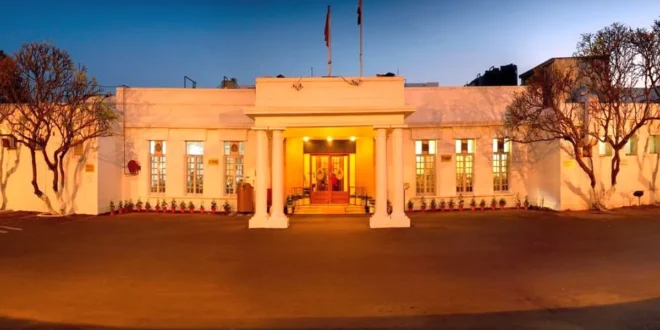
In the leafy heart of New Delhi, behind old trees and colonial-era walls, sits one of India’s most exclusive institutions: the Delhi Gymkhana Club. For decades, it has symbolised privilege, influence and access, a gathering place for diplomats, senior bureaucrats, military officers, industrialists and political elites.
Now, the club has become the centre of a political and cultural storm.
The Indian government has instructed the historic club to hand over its expansive 27-acre estate near the Prime Minister’s residence, arguing that the site is needed for national security and key infrastructure projects. Authorities claim the property lies within a strategically sensitive zone and is required for defence-related use.
But the move is being interpreted as much more than a property dispute.
For many supporters of Prime Minister Narendra Modi, the move is seen as a long-overdue attempt to break the grip of an old colonial-style elite culture that, for years, enjoyed influence and privilege on prime government-owned land. Critics, however, argue that it reflects a growing pattern of the government tightening its hold over powerful institutions and reshaping spaces once closely tied to India’s traditional establishment.
Established in 1913 during British rule under the name Imperial Delhi Gymkhana Club, the institution managed to retain its prestige long after India gained independence. Over the decades, it grew into one of New Delhi’s most exclusive social clubs, where gaining membership could take years sometimes even decades and connections within existing member circles often played a major role in who got accepted.
Over the years, the club increasingly became associated with what Indians often describe as “Lutyens’ Delhi” shorthand for the deeply interconnected network of political power, bureaucracy and influence concentrated in the capital’s elite circles.
The eviction order has sparked a strong backlash from both members and staff. While members are said to be preparing a legal challenge against the government’s decision, many of the club’s employees are now worried about their future, fearing they could lose their jobs and source of income if the takeover moves ahead.
The political response has been sharply split. Opposition leaders have accused the government of using national security as a convenient excuse to take control of valuable public land, while supporters argue that elite private clubs occupying vast public spaces no longer reflect the needs or priorities of modern India.
The dispute also highlights the wider changes India has experienced under Narendra Modi’s leadership. Since taking office in 2014, his government has often presented itself as taking on long-standing elite circles and powerful old networks. At the same time, critics argue that this shift has come with growing centralisation of power and a shrinking space for independent institutions within public life.
Beyond politics, the battle over the Gymkhana Club touches a deeper national question: who truly owns public space in modern India?
For some, these elite clubs are relics of colonial hierarchy that continue to reserve prime land and influence for a privileged few. For others, they are historic institutions woven into the social and cultural fabric of the capital.
Whatever the outcome, the confrontation has already become symbolic. It is no longer just about a club, a lease, or even a piece of land in central Delhi. It is about the changing balance between state power, public identity and the old networks that once quietly shaped India from behind closed doors.